The Legal Status of Research Peptides in the UK: A Regulatory Overview
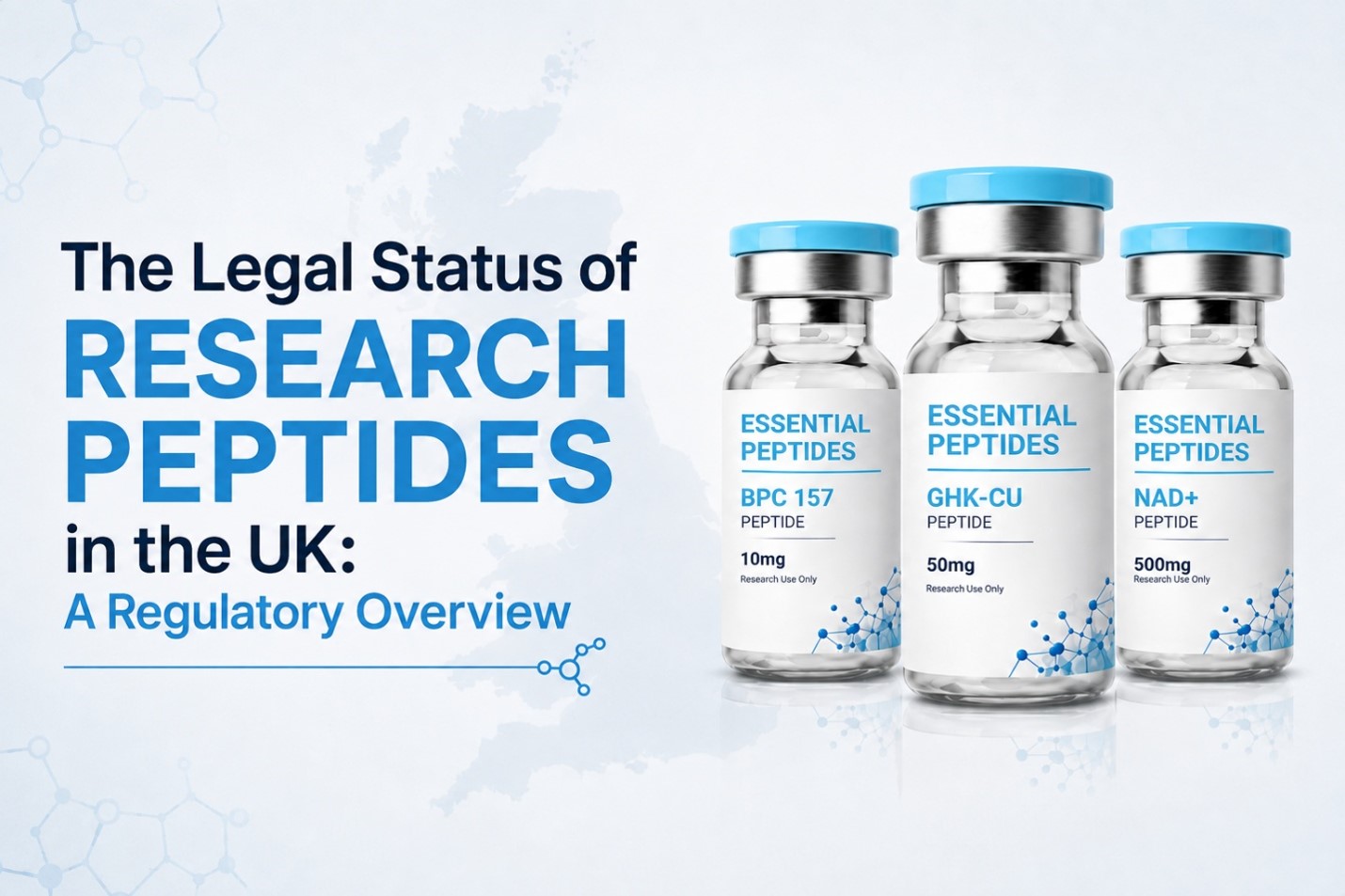
The UK market forresearch peptides has expanded considerably in recent years, drawing interest from laboratories, universities, and independent researchers alike. With that growth has come a legitimate need for clarity. Regulatory boundaries determine what a supplier can lawfully sell and how a buyer can lawfully purchase, and misunderstanding those boundaries carries genuine consequences. This overview sets out the legislation that governs peptide supply in the UK and explains precisely where compliant practice begins and ends.
The Regulatory Framework Explained
UK oversight of peptide compounds does not stem from one single law. It is shaped by several distinct pieces of legislation, each addressing a different aspect of supply, classification, and use.
The Misuse of Drugs Act 1971
This Act establishes the classification system for controlled substances, organized into Class A, B, and C categories. The majority of research peptides, including widely studied compounds such as BPC-157 and TB-500, are not listed under this framework. As unscheduled substances, their possession for legitimate research purposes does not constitute a criminal offense.
Certain exceptions apply. Human growth hormone, known as somatropin, is classified as a Class C substance. Growth hormone releasing peptides such as CJC-1295, Ipamorelin, and Sermorelin are chemically distinct compounds and are not subject to the same classification, a distinction that buyers should understand clearly before purchasing.
The Human Medicines Regulations 2012
This regulation carries the greatest practical weight for commercial peptide supply. Any product intended to treat, prevent, or diagnose a condition in humans is legally defined as a medicine. Supplying such a product without a marketing authorization from the Medicines and Healthcare products Regulatory Agency (MHRA) is unlawful, irrespective of how the product is described elsewhere.
Conditions for Lawful Supply
The classification of a peptide as a legitimate research reagent depends less on the compound itself and more on how it is presented and marketed. Lawful supply generally requires the following:
- Explicit labeling as intended for laboratory or in-vitro research use only
- No therapeutic, medicinal, or performance-related claims associated with the product
- No dosing or administration guidance directed at human use
- Packaging and product descriptions that do not refer to consumption
- Continued adherence to standard consumer protection and trading regulations
A product that satisfies each of these conditions remains outside the scope of medicines regulation. A single deviation from this standard can alter its legal status entirely.
Common Compliance Failures
Regulatory assessment does not rely on isolated disclaimers. The MHRA evaluates the overall impression created by a website or listing in its entirety. Several practices are known to shift a research compound into unlicensed medicine territory:
- Providing reconstitution or injection instructions written for personal rather than laboratory application
- Making claims relating to recovery, anti-aging, weight management, or general wellbeing
- Publishing customer testimonials describing personal outcomes or effects
- Structuring marketing language as though the product is intended for consumption
A research-use disclaimer positioned at the foot of a page does not offset content elsewhere that reads as guidance for human use. Regulators consider the complete context, not isolated statements.
Prescription-Only and Controlled Exceptions
Certain peptides fall outside the standard research category altogether, and this distinction deserves particular attention.
GLP-1 Medicines
Compounds including semaglutide and tirzepatide are licensed medicines within the UK when supplied for metabolic or weight management purposes. These are classified as prescription-only medicines and may be dispensed exclusively through a GPhC-registered pharmacy against a valid prescription. Supplying these compounds outside that regulated channel presents considerable legal risk, regardless of accompanying research disclaimers.
Controlled Peptides
As previously noted, somatropin remains a controlled substance under UK law. Buyers and suppliers alike should maintain a clear understanding of which compounds sit within this narrower category, distinct from the broader range of unscheduled research peptides.
Identifying a Compliant Peptide Supplier
Selecting a reputable peptide supplier in UK that businesses and researchers can rely on requires attention to several practical indicators. A compliant operator typically demonstrates the following:
- Consistent, unambiguous research-use labeling applied across the entire product range
- Independent laboratory testing supported by a Certificate of Analysis for each batch
- Absence of dosing charts, administration instructions, or health-related claims
- Transparent information regarding sourcing, purity standards, and storage requirements
- Professional customer communication centered on product information rather than promotional health guidance
A credible research grade peptides UK supplier does not depend on ambiguous marketing to support its catalog. Verifiable documentation and consistent labeling practices demonstrate compliance far more effectively than promotional language.
The Wider Value of Regulatory Awareness
Understanding this framework benefits buyers as much as suppliers. Researchers, clinics, and resellers who source from a compliant peptide company in the UK reduce their exposure to products that may be poorly documented, inconsistently tested, or legally uncertain. This awareness also contributes to a more accountable market, where testing standards and documentation carry genuine substance rather than functioning as a formality.
Working with an established supplier that understands these regulatory boundaries is generally associated with more consistent product quality and clearer communication regarding testing and storage practices.
Cross-Border Purchasing and Customs Considerations
Buyers sourcing peptides from suppliers outside the UK face an additional layer of regulatory exposure that domestic purchases do not carry. Import consignments are subject to inspection by UK Border Force and HM Revenue and Customs, and shipments lacking clear research-use documentation are more likely to be delayed, seized, or queried at the point of entry. This risk increases further when the originating supplier operates without independent testing standards or verifiable batch records, leaving the buyer unable to demonstrate the compound’s intended purpose if questioned.
Sourcing from a UK-based peptide supplier UK researchers can verify domestically removes much of this uncertainty.
Conclusion
The regulatory position governing research peptides in the UK is more structured than it initially appears. Legal risk rarely originates from the compound itself. It originates from how that compound is labeled, marketed, and positioned for use. Suppliers and buyers who remain firmly within the research-use category, avoid therapeutic claims, and prioritize transparent testing documentation operate well within established legal boundaries.
At Essential Peptides, our entire catalog is structured around this principle, supplying laboratory-grade materials with clear documentation and no ambiguity regarding intended use.
Frequently Asked Questions
Are research peptides legal to purchase in the UK?
Yes. Research peptides may be lawfully purchased provided they are supplied strictly for laboratory research, carry no therapeutic claims, and are not marketed for human consumption.
Is a licence required to purchase research peptides from a UK supplier?
No licence is required for standard, unscheduled research peptides acquired for genuine research purposes. Controlled substances and prescription-only medicines are the exceptions to this position.
Is BPC-157 classified as a controlled substance in the UK?
No. BPC-157 is not currently scheduled under the Misuse of Drugs Act 1971 and may be lawfully supplied as a research reagent.
What should be verified before selecting a peptide supplier UK researchers can depend on?
Buyers should confirm the availability of independent batch testing, a published or accessible Certificate of Analysis, consistent research-use labelling, and the absence of dosing or health-related claims across the site.