Third-Party Testing vs In-House Testing: Why It Matters for Research Peptides
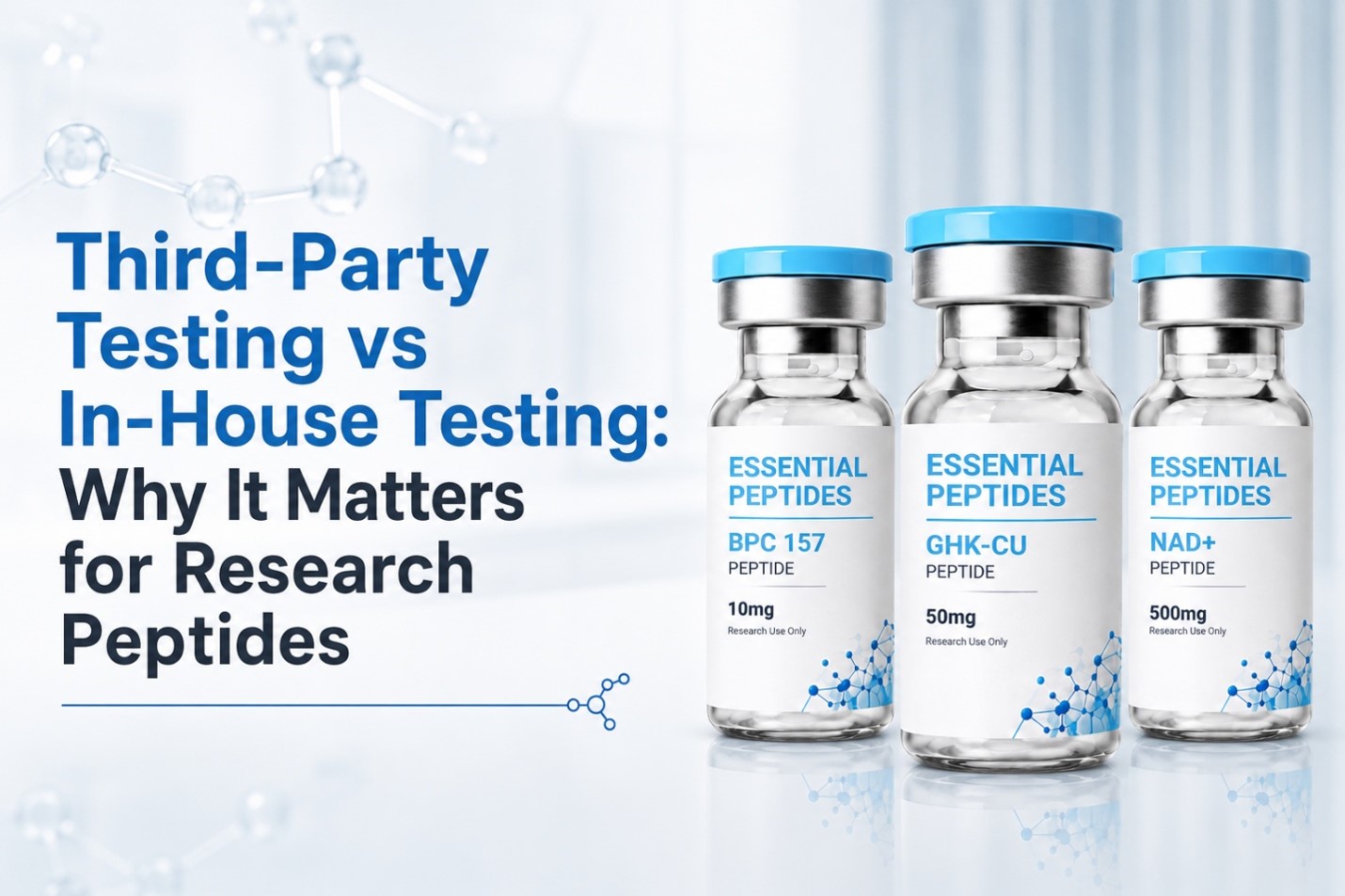
Every researcher sourcing peptide eventually faces the same fundamental question: what verification actually stands behind a product’s stated purity? Two testing models dominate this industry, in-house testing and third-party testing, and understanding the distinction between them is essential for anyone seeking research grade peptides uk-wide. The method a supplier relies on directly influences the reliability of the data researchers ultimately produce.
This blog examines both testing approaches, explains why independent verification carries greater scientific weight, and outlines what researchers should look for before selecting a supplier.
Understanding In-House Testing
In-house testing occurs when a supplier analyses its own products using internal equipment and personnel. Many manufacturers use this as a preliminary quality control measure before goods reach the market.
While internal testing serves a purpose, it operates without external oversight. The organization conducting the test is also the organization profiting from the result, which introduces an inherent conflict of interest.
Several limitations are commonly associated with in-house testing:
- Results are rarely published in complete, verifiable form
- No external laboratory confirms the accuracy of the findings
- Testing methodology and calibration standards are not independently reviewed
- Buyers must rely entirely on the supplier’s own reporting
This does not suggest that internal testing is inherently inaccurate. It indicates that no independent authority has confirmed the outcome.
Understanding Third-Party Testing
Third-party testing involves sending a peptide sample to an unaffiliated laboratory that holds no financial interest in the sale. That laboratory conducts its own analysis, typically using High-Performance Liquid Chromatography (HPLC) or Mass Spectrometry, and issues a Certificate of Analysis based strictly on its findings.
This process establishes a critical layer of accountability. Independently tested peptides are verified by a party with no incentive to overstate purity or underreport contamination, which gives researchers a considerably more dependable basis for their work.
Why This Distinction Carries Scientific Significance
Purity levels influence research outcomes directly. A peptide verified at 92 percent purity will not perform identically to one confirmed at 99 percent under controlled research conditions. Impurities can introduce unpredictable variables, distort measurements, and compromise the validity of results.
Independent verification specifically addresses three critical concerns:
- Identity confirmation – confirming the compound is the exact peptide claimed, rather than a structurally similar substitute
- Purity accuracy – establishing a precise, laboratory-confirmed percentage rather than an estimated figure
- Contaminant detection – identifying residual solvents, heavy metals, or bacterial contamination that internal testing may not detect
Identifying Genuinely Lab Tested Peptides
Not every testing claim published online reflects a verified process. Researchers seeking lab tested peptides in the UK should understand the components of a credible Certificate of Analysis before relying on a supplier’s claims.
A legitimate certificate should include the following details:
- The name and accreditation status of the testing laboratory
- A batch number corresponding to the specific product received
- The analytical method applied, such as HPLC-UV or LC-MS.
- A precise purity percentage rather than a generalized description
- A recent, batch-specific date of analysis
A supplier unable to provide this documentation on request should be regarded with appropriate caution.
Indicators That Warrant Further Scrutiny
Certain patterns recur across suppliers whose testing claims lack substance:
- Certificates that appear identical across unrelated product listings
- Absence of a named, verifiable testing laboratory
- Purity figures that remain unchanged across every batch
- General statements such as “independently verified” with no supporting documentation
Authentic testing produces a traceable record. Anything less remains an unverified assertion rather than evidence.
The Research Implications of Testing Standards
Scientific research depends on consistency and reproducibility. When a peptide’s composition varies undisclosed between batches, results become difficult to replicate, undermining the reliability of the research itself.
Selectingpremium research peptides backed by consistent, independently verified testing protects the integrity of the research process, not merely the financial investment involved. A single unverified or inconsistent batch can compromise an extended period of carefully structured study.
Suppliers that publish certificates openly, rather than providing them only upon request, typically demonstrate greater confidence in the consistency of their sourcing and manufacturing standards.
Questions Researchers Should Ask Before Ordering
Prior to selecting a supplier, researchers should consider the following:
- Is the testing laboratory clearly named and independently verifiable?
- Does the certificate correspond to the specific batch being purchased?
- Is the purity percentage specific and laboratory-confirmed, rather than rounded?
- Are certificates provided consistently across the full product range?
A supplier with confidence in its sourcing standards will address these questions without hesitation.
Supplier Accountability and Long-Term Reliability
A supplier’s approach to testing often reflects its broader approach to accountability. Businesses that commission independent verification consistently, rather than occasionally, tend to maintain tighter control over sourcing, storage, and batch tracking as well.
This matters for researchers who order repeatedly over months or years. A supplier that treats testing as an ongoing standard, rather than a one-time marketing claim, is far more likely to maintain consistent quality across every subsequent purchase.
Several indicators point to a supplier built around long-term accountability:
- Testing applied uniformly across the entire product catalog, not selected items
- Batch records maintained and made available on request
- Willingness to address discrepancies transparently rather than dismissing them
Researchers benefit most from suppliers who treat verification as a continuous commitment rather than an isolated compliance exercise.
Why Verified Purity Justifies the Investment
Pricing within the research peptide market varies considerably, and cost alone offers little insight into quality. A lower price paired with unverified purity often represents a greater long-term expense, particularly when compromised results require repeated trials or unusable data must be discarded entirely.
Independent verification adds a measurable cost to production, which is precisely why suppliers who invest in it consistently tend to price their products accordingly. Researchers evaluating cost should weigh it against the reliability of the outcome, not against the listed price in isolation. A verified, higher-purity compound frequently proves more economical across the course of a study than a cheaper, unverified alternative that introduces uncertainty into the results.
Conclusion
The distinction between in-house and third-party testing extends beyond procedural preference. It determines whether researchers can rely on documented evidence or must depend on unverified assurances regarding a product’s composition. Independent testing exists specifically to provide the external accountability that self-reported results cannot offer.
At Essential Peptides, we recognize that transparency in testing forms the foundation of responsible research supply, and independently verified quality remains central to the standards we maintain across every product we offer.
Frequently Asked Questions
1. What distinguishes third-party testing from in-house testing?
Third-party testing is conducted by an independent laboratory with no financial interest in the outcome, whereas in-house testing is performed internally by the supplier without external verification.
2. Why is it important to choose independently tested peptides?
Independent testing removes conflicts of interest and provides objective confirmation of identity, purity, and contamination levels, supporting more reliable research outcomes.
3. How can researchers confirm the validity of lab tested peptides UK suppliers claim to provide?
A valid certificate should specify a named, accredited laboratory, a matching batch number, the analytical method used, and a precise purity percentage rather than a general assurance.
4. Does purity level meaningfully affect outcomes when using research grade peptides UK wide?
Reduced purity introduces variables that can compromise data accuracy, making verified purity a critical factor in achieving consistent, reproducible research results.